Tootie
The TrenchTootie is a gray whale calf released by Sea World after having stranded along OceanShores. Unable to keep pace with migrating whales, she takes refuge in Grays Harbor, where abundant food sustains her; there, the presence of an escaped Megalodon turns that refuge into a dangerous point of overlap between animal lives and human efforts to track and capture them. The novel gives Tootie a brief but distinct strand of action, centered on feeding, seeking shelter, and responding to danger rather than on the explanations humans make about her.
Identity and Return to the Wild
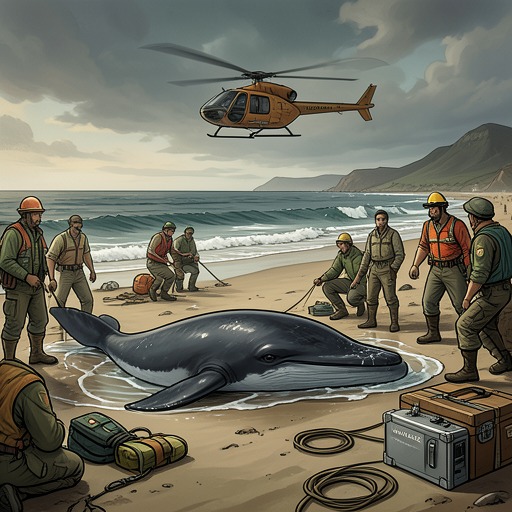
Tootie is described as an 18,000-pound gray whale calf. She had beached herself along OceanShores four months before the report of her return to the wild, and Sea World released her weeks before the events in Grays Harbor. A news account links her situation to the escaped Megalodon, noting that fishermen had sighted the shark off Leadbetter Point and that Tootie was feeding less than 25 miles from where it was last reported. The report presents her as a newborn whose attempted northward migration to the Bering Sea appears to have stalled.
That account also makes Tootie the subject of a public dispute about the timing of her release. An animal-rights activist argues that Sea World should have waited until the Megalodon had been recaptured. A Sea World animal-care supervisor objects that the report omits a crucial chronology: Tootie was released at least a week before the shark escaped. The correction does not remove the danger surrounding her, but it complicates the report’s implied connection between the release and the shark’s presence.
Feeding and Refuge in Grays Harbor
The narrative shows why Tootie remains in the harbor: she cannot keep up with the migrating whales and has found shelter where food is plentiful. She plows along the muddy bottom, drawing in turbid water and filtering sandhoppers and other bottom-living organisms from the silt through her baleen. After feeding for several minutes, she surfaces to breathe, then returns to the seabed. Her repeated descent and return establish a routine shaped by the harbor’s resources, not simply by the human concern that she has failed to continue north.
Tootie also feeds at the surface, scooping kelp into her mouth and straining the small sea creatures attached to its leaves through her baleen. After swallowing, she breathes and submerges again. The change between bottom-feeding and feeding on kelp presents her as actively using the different food sources around her, even as the surrounding human narrative treats her location as a problem to monitor.
Encounter with the Megalodon
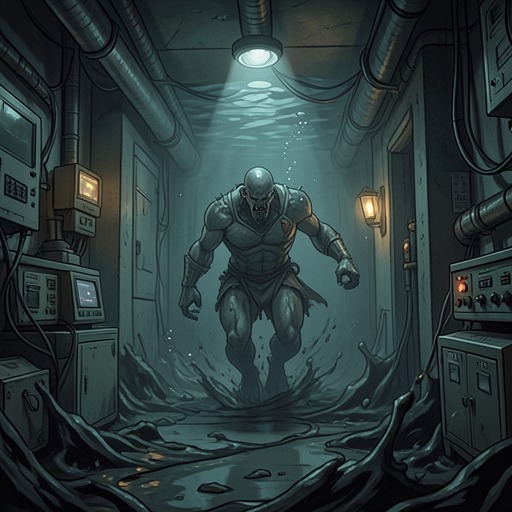
While descending through the murk, Tootie registers another presence approaching quickly and stops swimming. A luminescent blur then rushes toward her along the seafloor; sensing danger, she turns and retreats toward the surface. The scene gives her response without assigning her human motives or thoughts: the approach is detected, movement halts, and flight follows.
Later, a trawler crew reports that it has caught Tootie in its net and is towing her in. The crew says she is struggling and believes the Megalodon is circling nearby. From a helicopter, Jonas Taylor sees the submerged net and an ivory shape amid what appears to be a battle below the surface. The account ends without establishing Tootie’s fate. Her capture has not secured her safety; instead, the net places her in immediate difficulty while the predator remains close.
Narrative Significance
Tootie’s scenes move between human accounts of her and the practical conditions of her life in the harbor. News coverage and animal-rights commentary debate the timing of her release, while the correction from Sea World challenges the report’s chronology. The feeding passages shift attention away from that dispute to the calf’s need for food and refuge, and the encounter with the Megalodon makes her presence consequential in the larger pursuit of the shark.
Her strand also resists resolving an animal’s survival into a human success story. Sea World’s tracking and the trawler’s capture make Tootie visible to people, but the closing image leaves her in danger rather than safely recovered. Her unresolved outcome preserves the distinction between human efforts to manage the crisis and the uncertain life of the whale caught within it.